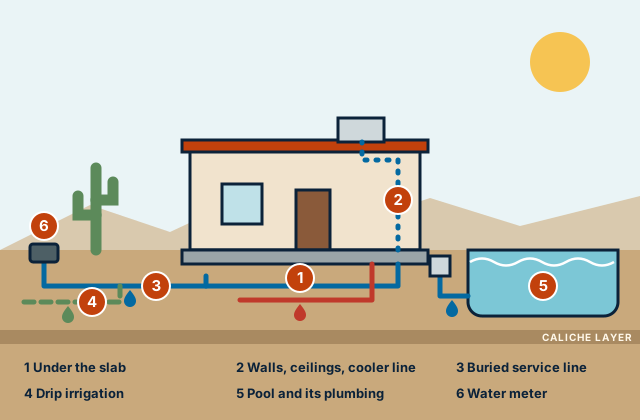
Leak Detective finds hidden water leaks in Tucson homes and commercial properties: under the slab, inside walls and ceilings, in the buried line from the meter, in pools, and in drip irrigation. We locate the leak and mark the exact spot, so the repair can be made in one place with as little damage as possible.
Six places water leaks hide on a typical Tucson property.
Certifiedin leak detection
5+ yearsof leak detection experience
Non-invasiveleaks located from the surface
Based in Tucson1190 E Pennsylvania St, 85714
What we do
Hidden water leak detection for Tucson homes and businesses
Leak detection is the job of finding exactly where a pressurized pipe, a drain, a pool, or an irrigation line is losing water when you can't see it. Most hidden leaks in Tucson are found with a combination of meter readings, pressure testing, acoustic listening, thermal imaging, and pipe tracing. Done properly, it turns "there's a leak somewhere under the house" into a marked spot on the floor or in the yard.
Leak Detective does that one job. We have more than 5 years of leak detection experience, we're certified in leak detection, and we work for homeowners, landlords, property managers, and businesses across Tucson.
A leak at a buried pipe connection. Most leaks we find are out of sight like this one was. (Stock photo)
We're a detection-only company. We don't open slabs, replace pipe, or patch pools. Once the leak is located and marked, you hire the plumber, pool company, or landscaper you choose to fix it.
That matters for 2 reasons. A plumber who knows where to cut does less damage and spends less time. And because we don't earn anything from the repair, a finding of "one small leak, simple fix" costs us nothing to say.
Services
Residential and commercial leak detection services in Tucson
Each of these is a different kind of search with different tools. The numbers match the diagram at the top of the page.
For warm spots on the floor, the sound of water with everything off, or damp flooring. We isolate the hot and cold lines under the concrete and pinpoint the leak so the slab is opened in one place, or not at all if a reroute makes more sense.
For stains, bubbling paint, musty smells, and swollen baseboards. The first question is whether the water is from a supply pipe, a drain, a shower, a cooler line, the AC, or the roof. We sort that out before anyone cuts drywall.
For a meter that keeps turning with the house valve shut. We trace the buried service line between the meter and the house and mark where it's leaking, including under driveways and gravel.
For drip and sprinkler systems that are using far more water than the plants are getting. We separate the mainline from the zones and find breaks, weeping valves, and chewed tubing under rock and gravel.
For pools that lose more water than Tucson's evaporation explains. We pressure test the plumbing lines and dye test the shell, skimmer, lights, and fittings to find where the water is leaving.
For a Tucson Water bill that jumped with no visible cause. We start at the meter, work out which part of the property is using the water, and then track the leak down from there.
Learn more
More leak detection services in Tucson
Some problems need a narrower search than the 6 above.
You can confirm most leaks yourself in half an hour. This is the same check Tucson Water recommends, and it tells us where to start.
Turn off everything that uses water. Faucets, the washer, the dishwasher, the ice maker, the evaporative cooler, the irrigation timer, and the pool autofill.
Look at the meter. On a dial meter, note where the needle is. On a digital meter, look at the flow rate screen. Any flow rate other than zero means water is moving.
Wait 15 to 30 minutes and look again. If the needle moved or the reading changed, something is leaking.
Shut the house valve and repeat. If the meter still moves, the leak is between the meter and the house. If it stops, the leak is inside the house or under it.
Who is responsible for a water leak past the meter
Tucson Water is responsible for the main and the meter. Everything past the meter on your property is yours, and the utility doesn't locate leaks on private property. That's the gap a leak detection company fills.
What to do with the result
Write down what the meter did with the house valve open and closed. If you can, take 2 meter readings an hour apart with nothing running. That gives a rough leak rate, which helps us judge how urgent it is and how hard the leak will be to hear.
If the meter doesn't move at all but you still have a stain or damp area, the source is probably a drain, a shower pan, an appliance, or the roof. That's still something we track down. See wall leak detection and drain leak detection.
Methods
Non-invasive leak detection: how we find a leak without damage
No single instrument finds every leak. A leak is located by narrowing it down in stages and then confirming the spot with at least 2 methods that agree.
Pressure testing and line isolation
Shutting valves and pressurizing one section at a time shows which line is losing pressure: hot or cold, house or yard, pool suction or pool return. This step alone rules out most of the property.
Acoustic leak detection
Water escaping a pressurized pipe makes noise that travels through the pipe, the concrete, and the soil. A ground microphone picks up where that sound is loudest. It works best on metal pipe under hard surfaces.
An infrared camera shows temperature differences on floors, walls, and ceilings. A hot water slab leak often shows as a warm bloom on the floor. Wet drywall usually reads cooler than dry drywall.
Pipe locating and line tracing
Before listening for a leak, we need to know where the pipe runs. A locator traces metal lines from a transmitted signal. Plastic lines need other methods, which is one reason they take longer.
Tracer gas leak detection
When a leak is too small or too deep to hear, the line can be emptied and filled with a safe hydrogen and nitrogen mix. The gas escapes at the leak, rises through soil or concrete, and is picked up by a sensor at the surface.
Sewer and drain camera inspection
Drain and sewer pipes carry no pressure, so they make no noise. We test them by plugging the line and filling it with water, and inspect them with a camera whose position can be located from the surface.
Moisture mapping and dye testing
A moisture meter shows how far water has spread inside a wall or floor, which points back toward the source. In pools, showers, and toilets, a small amount of dye shows whether water is being pulled into a crack or fitting.
A handheld thermal imaging camera reads surface temperature. (Stock photo)
Local conditions
What causes water leaks in Tucson homes
Local construction and climate decide where leaks show up here, and how they hide.
Slab foundations and homes from the 1970s onward
Census housing data compiled by the University of Arizona shows that the largest share of Tucson-area homes was built in the 1970s, and 74% were built between 1970 and 2009. Most of those homes sit on a concrete slab with water lines run through or under it.
When one of those lines fails, there's no crawlspace to look into. The leak has to be found from above.
Hard water from a blended supply
Tucson Water delivers a blend of Colorado River water brought in by the Central Arizona Project and local groundwater. It's hard water, and hardness varies across the system.
Mineral scale shortens the life of valves, water heater fittings, cooler floats, and toilet fill valves. Those small parts account for a large share of the "mystery" water use we trace.
Dry soil, caliche, and gravel yards
In a wet climate, a leaking yard line makes a green, soggy patch. In Tucson, dry soil soaks up a steady leak for months, and a hard caliche layer can send the water sideways so it surfaces well away from the break, or never surfaces at all.
Rock and decomposed granite yards hide it further. The meter is often the only witness.
Monsoon storms and winter freezes
Tucson gets a little over 10 inches of rain a year, and about half of it falls in the monsoon, which the National Weather Service defines as June 15 through September 30. A ceiling stain in that window may be a roof leak or a plumbing leak, and it takes testing to tell them apart.
Winter matters too. The city averages around 12 nights a year at or below freezing, enough to crack exposed backflow preventers, hose bibs, and irrigation fittings.
Pricing
Leak detection cost in Tucson: what affects the price
Leak detection cost depends mainly on how many systems have to be tested, what the pipe is made of, and how hard the leak is to reach and hear. We give you a price for your situation when you call and describe it. We don't publish a flat rate because the jobs differ too much.
How many systems are on the property. A house with a pool, a spa, and 6 irrigation zones takes longer to isolate than a house with none of those.
Pipe material. Copper carries leak noise well. PVC, PEX, and polyethylene don't, so plastic lines often need tracer gas or more time.
What covers the pipe. Bare slab and tile are easier to listen through than thick carpet pad, wood flooring over a moisture barrier, or deep landscape rock.
Size of the leak. Larger leaks are louder and faster to find. Slow, intermittent leaks take longer.
More than one leak. Older lines sometimes have 2 or 3. Each one has to be found and confirmed separately.
Working shutoff valves. If the house valve or irrigation shutoff is seized or missing, isolation takes more work.
When a water leak is an emergency
Most hidden leaks are urgent but not an emergency. You have time to shut the water off and schedule detection. Treat it as an emergency and shut the water off right away if:
Water is coming up through the floor or running out from under a wall.
A ceiling is sagging or bulging with water. Stay out from under it.
Water is near outlets, light fixtures, or the electrical panel. Switch off the breaker for that area if you can reach it safely.
The meter is spinning fast with everything turned off.
Water is washing out soil next to the foundation, a wall, or the driveway.
Close the main house valve first. It's usually where the water line enters the house, often near the front hose bib. If that valve won't turn or doesn't stop the flow, shut off at the meter box or call Tucson Water to have the meter turned off.
Then call us at (520) 680-0231. With the water off the damage stops, and the leak can still be found.
You call and describe the problem. You speak with Leak Detective directly. We ask what you have seen, what the meter is doing, the age of the home, and whether there's a pool or irrigation system.
We confirm the leak at the meter. On site, the first step is measuring whether water is being lost and roughly how fast.
We isolate the system. House, yard line, irrigation, and pool are separated one at a time until we know which one is leaking.
We pinpoint the location. Using the methods that suit the pipe and the surface, we narrow the leak to a specific spot and confirm it a second way.
We mark it and explain it. The location is marked on the floor, wall, or ground. We walk you through what we found, how sure we are, and what a repairer will need to know.
You choose who repairs it. We don't do the repair. You can give our findings to any plumber, pool company, or irrigation contractor, and to your insurer if you're making a claim.
Sometimes the honest answer is that the meter shows no loss and no leak can be confirmed. If that's the result, we tell you so, along with what else could explain the symptom.
Service area
Leak detection service areas in Tucson
Leak Detective works throughout Tucson: downtown and the historic neighborhoods around it, midtown, the east side, the southeast side, the northwest, and the foothills. The kind of leak we get called for changes with the age and style of the housing, so we have written up what to expect in several parts of town.
Acreage and horse properties on the northeast side, some on private wells, with long water runs to barns and corrals.
Elsewhere in Tucson
If your neighborhood isn't listed, call (520) 680-0231 with your cross streets and we'll tell you whether we can get to you.
Water leak detection questions Tucson homeowners ask
How do I know if I have a hidden water leak?
Turn off every fixture and appliance that uses water, then watch your water meter for 15 to 30 minutes. If the dial needle moves, or a digital meter shows any flow rate above zero, water is leaking somewhere past the meter. Other signs are a bill that climbs for no reason, a warm spot on the floor, the sound of running water with everything off, and stains or damp areas that don't dry out.
Does Leak Detective repair the leak after finding it?
No. Leak Detective is a detection-only company.
We locate the leak, mark the spot, and explain what we found. You then hire a plumber, pool company, or irrigation contractor of your choice to make the repair.
Will you have to break concrete or cut drywall to find the leak?
Usually not. Most leaks are located from the surface with pressure testing, acoustic listening, thermal imaging, and tracer gas.
Occasionally a small inspection opening is the only way to confirm a source inside a wall, and we ask before making one. Opening the slab or the yard is repair work, and it happens after the leak has been marked.
How long does leak detection take?
A single leak on a copper line under a slab can often be found in one visit of a couple of hours. Plastic pipe, very slow leaks, multiple leaks, and properties with pools and large irrigation systems take longer. We give you a realistic time estimate once we know what the meter is doing and what is on the property.
How much does leak detection cost in Tucson?
It depends on how many systems need testing, the pipe material, the surface over the pipe, and how small the leak is. A house-only search is a different job from a house, pool, and irrigation search. Call (520) 680-0231, describe what you're seeing, and we'll give you a price for your situation before we come out.
Will Tucson Water find the leak for me?
No. Tucson Water can check for a leak at the meter through a High Bill Investigation, but the utility doesn't locate leaks on private property.
Anything past the meter is the property owner's responsibility. Tucson Water does offer bill adjustments for high use caused by leaks, so ask their customer service what they need from you.
Does homeowners insurance cover leak detection?
It depends on your policy. Some policies pay for the cost of finding a covered leak and for the resulting water damage, but not for the pipe repair itself.
Check with your insurer before work starts. We can explain our findings clearly so you have something specific to give your adjuster.
Should I turn my water off while I wait?
If water is damaging the house, yes. Shut the main house valve or the meter and open it only when you need water.
If the leak is slow and outside, you can usually leave the water on. Either way, tell us what you did, because we need pressure in the line to locate most leaks and will turn it back on during testing.
Need a leak found in Tucson? Call and describe what you're seeing.
Tell us what the meter is doing, where the water or the stain is, and what kind of property it is. We'll tell you which type of leak detection fits and set up a visit.